
Ohio County Release Records
The Ohio County Detention Center is the county's local booking and detention facility. Jailer Landon Spurlock operates it independently of the sheriff, the Kentucky Department of Corrections, the federal Bureau of Prisons, and immigration authorities. That division controls where a useful record lives. A county booking screen or release entry documents a local exit. A court order supplies the legal basis. KOOL and a KDOC Daily Releases report apply when the person entered state corrections jurisdiction.
“Released” is not one outcome. It can mean a return to the community on bond, completion of a sentence, probation, parole, mandatory reentry supervision, or discharge. It must not be used for a move to another jail, a state prison, federal custody, or ICE. Escape and death are also separate custody events. The official live roster mainly answers whether a person appears in the jail's current data. If a name has vanished, the next record must identify why.
- Bond
- Conditional release from pretrial custody while the court case continues.
- Time served
- Completion of the custodial time recorded for the matter.
- Parole
- Conditional community release under Parole Board authority before sentence expiration.
- Discharge
- Completion of the correctional obligation shown by the responsible agency.
- Detainer
- A request or hold that may send a person to another authority instead of the community.
Ohio County Custody Exit Types
A record should preserve the agency's exact exit label. Replacing a transfer with “released,” or treating parole as full sentence discharge, changes the meaning. The local jail record, the court docket, and state corrections records answer different parts of the event.
| Exit type | Meaning | Best next source |
|---|---|---|
| Bond or court order | Local custody ends under court authority, but the case may continue. | Jail release entry and Ohio County court docket |
| Time served | The custodial part of the recorded sentence ends. | Jail record and judgment |
| Probation or shock probation | A court places the person in the community under stated terms. | Court order, then KOOL if KDOC supervises |
| Parole or reentry supervision | Physical custody ends while state supervision continues. | KOOL, Daily Releases, and District 13 |
| Transfer | Custody continues with KDOC, another jail, BOP, USMS, or ICE. | Receiving system and transfer record |
| Sentence discharge | The responsible correctional system records completion. | Jail record or KDOC release record |
A dismissal can explain why a case ended, yet it does not prove the exact jail exit time. Another warrant or hold may still control custody. Likewise, a booking photograph proves only that an image was made during booking. It does not establish present custody, release, or the outcome of the case.
Ohio County Release Record Fields
There is no single statewide form called an Ohio County release record. The useful document may be a release screen, booking record with an exit field, transfer notation, bond entry, court order, KOOL detail, or KDOC Daily Releases row. Request the existing record that matches the agency and event rather than asking staff to create a new timeline.
| Field | What it shows |
|---|---|
| Legal name and identifier | Connects the event to the correct booking or DOC record. |
| Admission date | Marks the start of the recorded custody episode. |
| Release date and time | States when processing occurred, if time is recorded. |
| Release type or reason | Distinguishes bond, completion, parole, discharge, or transfer. |
| Facility | Identifies the physical releasing location. |
| Court or case number | Links the jail event to its legal authority. |
| Bond notation | May show type, amount, or posting event. |
| Destination or hold | May identify a receiving agency or detainer rather than freedom. |
| Supervision | Shows parole, probation, or reentry status when applicable. |
Can roster absence serve as a release record? No. It only shows that the person was not displayed when the current roster was checked. A dated jail entry, a court order, a VINE event, or the correct state or federal record is needed to identify the exit.
Note: Ohio County publishes no fixed period during which a released person's entry remains visible on its live roster.
Request Ohio County Release Records
Direct detention records first to the Ohio County Detention Center and elected jailer, not automatically to the sheriff. A focused request should give the full name, birth date or booking number if known, and an estimated booking and exit range. Ask for the booking record, release or transfer entry, release date and type, court or case number, bond notation, public destination field, and booking photograph if needed.
- Describe the existing records with a narrow date range and enough identifiers to separate similar names.
- Send the signed request to the jailer by an accepted written channel. The Kentucky Attorney General's standard open-records form may be used.
- Ask for electronic delivery and for a cost estimate before copies are made.
- Request all reasonably separable public portions and a statutory explanation for any withheld part.
- If routing is uncertain, copy the Ohio County open-records custodian. Send KDOC record requests separately for state offenders.
108 East Washington Street
Hartford, KY 42347
270-298-4455, extension 4
Fax: 270-298-4451
Landon.Spurlock@ohiocountyky.gov
Ohio County's open-records policy accepts requests through the Judge Executive's office by mail, hand delivery, or email. It states a five-business-day response period, ten cents per standard page, and actual cost for special duplication. State law also requires a decision within five days excluding weekends and legal holidays. A request seeks records already held. It does not require the jail to answer questions or compile a custom report.
Kentucky Law on Release Records
Kentucky's Open Records Act, KRS 61.870 through 61.884, favors access while preserving statutory exceptions. KRS 61.872 permits a custodian to require a signed request with the requester's name, a precise description, and a residency statement. KRS 61.874 governs copy costs, advance payment, and postage. Staff time is not part of the ordinary noncommercial reproduction charge.
Public access does not mean every field must appear online. Privacy, active investigation, juvenile, medical, security, sealed, and expunged material may be withheld or redacted under applicable law.
Retention is record-series specific. Court files can move to a records center or be destroyed under an approved schedule. Expungement can change later visibility. Kentucky's official process starts with a certification, then a petition when required. For an Ohio County case, the local clerk is the starting point. A changed search result does not rewrite the historic fact that a custody event once occurred.
Ohio County Bond Release Route
The detention center publishes unusually precise bond instructions. Its bond information says the jail handles qualifying bonds up to $5,000 at any hour, every day of the year. The person posting must be at least 21, bring photo identification, and use cash. Bonds above that threshold are completed through the Ohio County Circuit Clerk.
The jail describes recognizance, unsecured, surety, and ten-percent partially secured bonds. These labels determine how release is secured, not whether the prosecution has ended. The case remains active unless a later court disposition says otherwise, and failure to appear can have serious bond consequences. Payment methods and amounts should be confirmed with the responsible office before anyone travels or pays.
Note: A bond entry and the court docket together provide stronger context than either source viewed alone.
Find Ohio County Released Inmates
A reliable search starts with the Ohio County system and follows the person only when the record points elsewhere. No county 24-hour or 72-hour release feed was verified. The live roster is still useful as the first current-custody check, but it cannot prove why a person disappeared.
- Search the official Ohio County inmate lookup with the legal name and spelling variants. Record when it was checked.
- If absent, search Kentucky VINELink and read the event wording. Do not turn “transfer” into “release.”
- Search KOOL when a felony sentence, state transfer, parole, or KDOC supervision is possible. Prefer a DOC number over a name alone.
- Check the Ohio County court case for bond, judgment, probation, dismissal, revocation, or another order.
- Call the jail for present status, then request the release or transfer record when written proof matters.
- Follow a stated destination into KDOC, another county, BOP, federal court, or ICE records.
A released person usually leaves the current jail roster. Absence is a clue, not proof of return to the community.
The Ohio County Detention Center release page gives the local facility route in more detail. When nothing appears online, request records from both the jailer and the Circuit Court Clerk with a date range and identifiers.
Ohio County KOOL Release Search
The Kentucky Department of Corrections calls its public tool Kentucky Offender Online Lookup, or KOOL. It can retain records after physical prison release, show active supervision, provide the DOC number used for requests, and connect sentence information with corrections dates. It is not a complete archive of all Ohio County bookings. A short county bond release may never enter KDOC data.
| Search field | How to use it |
|---|---|
| DOC number | Best way to separate people with similar names. |
| Name and aliases | Try legal spelling and known variations, then compare identifiers. |
| Offender or supervision status | Distinguishes custody, parole, reentry supervision, and other displayed states. |
| Location and county | May identify an institution or supervision office. |
| Projected Release Date From/To | Finds an administrative date range, not a promised exit. |
| Offense and conviction fields | Help match the correct case without replacing the court record. |
KDOC says entries are updated daily but are not guaranteed, and data newer than 120 days may not be final. A parole eligibility date, minimum expiration date, maximum expiration date, proposed release date, and actual discharge are different fields. For state-controlled exits, compare KOOL with the dated KDOC Daily Releases archive.
Ohio County Courts Explain Release
The jail records when staff processed an exit. The court record explains the legal authority. Ohio County's clerk manages Circuit, District, Family, and related records, while the local schedule separates District sessions from Circuit criminal motion days. District Court handles misdemeanors and preliminary stages of many felony cases. Circuit Court holds felony final dispositions.
Look for an order setting or changing bond, a bond-posted notation, dismissal, judgment and sentence, jail-time credit, probation, shock probation, revocation, amended charges, or a hold for another matter. One order may not free the person when another case, warrant, or detainer remains. The Ohio County Court of Justice page identifies clerk Shannon Kirtley and the local records route.
The official Ohio County court screen shows how local access is organized.
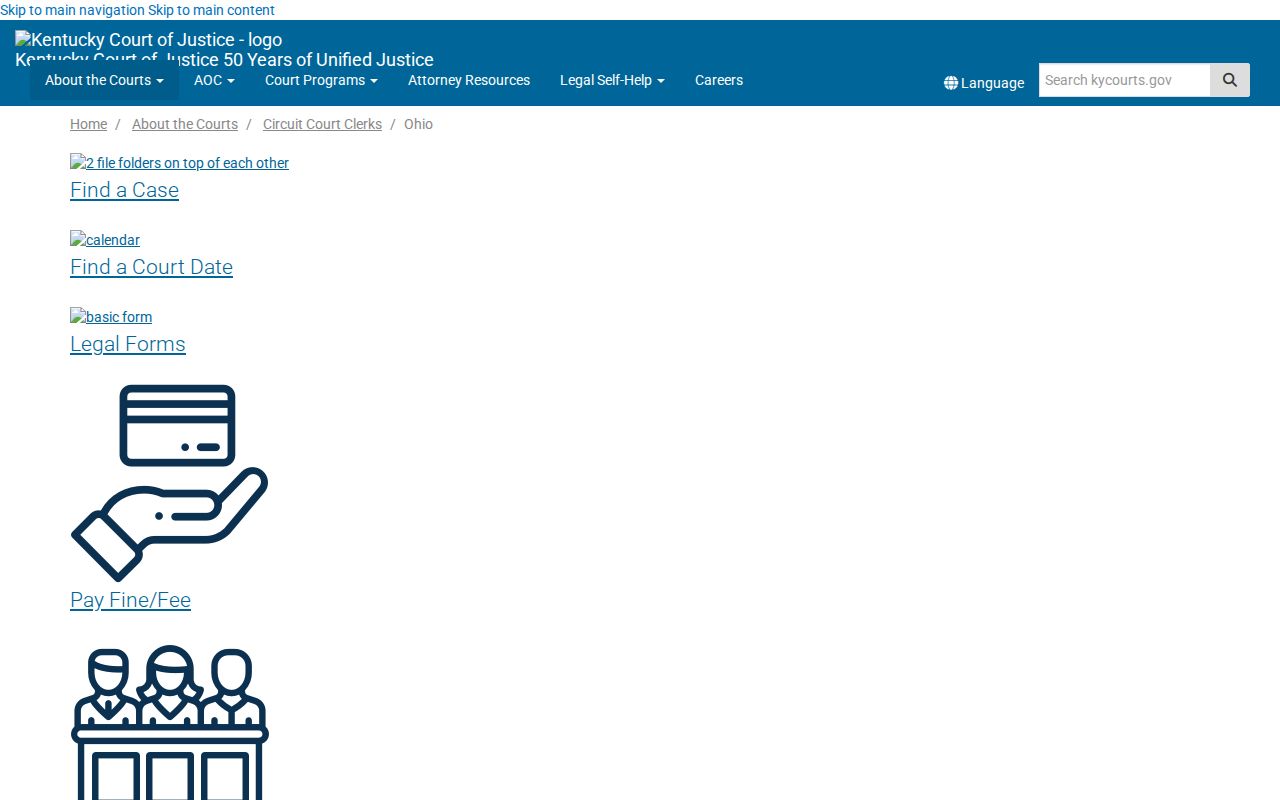
Use the clerk's record and jail entry together when the exact authority and processing date both matter.
Ohio County Release Status Channels
Kentucky VINELink covers participating local jail and state correctional data and permits notification registration. Select Kentucky, find the person by partial name or offender ID, compare the facility and identifiers, then read the status text. A local and a KDOC record may both exist. Register on each relevant record when alerts matter, and confirm every notice with the jail, KOOL, Daily Releases, or court.
The Kentucky VINELink screen shows the person-search and notification entry point.
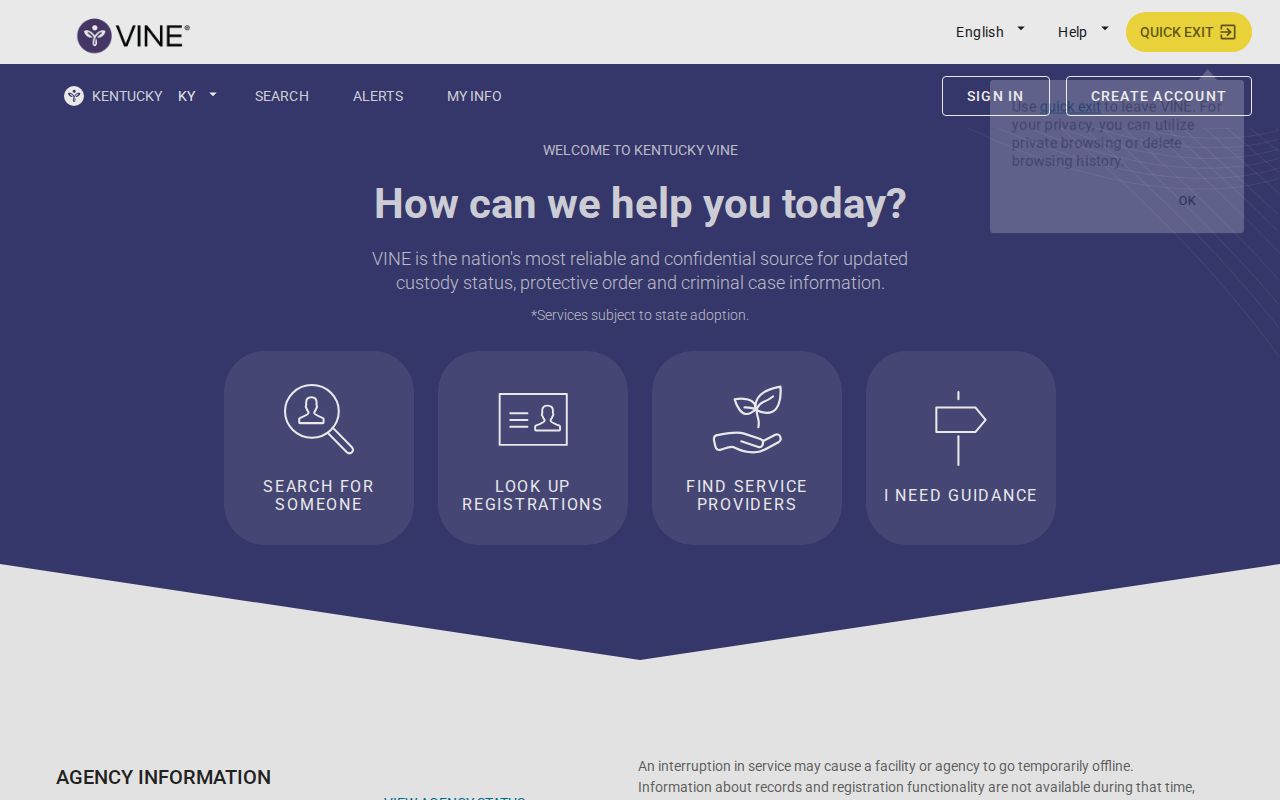
VINELink is a notification channel, not a browseable Ohio County recent-release list.
Federal cases use the BOP inmate locator. A past release date may document departure from BOP custody, while “Released” or “not in BOP custody” does not rule out custody by Kentucky, a county, or ICE. The ICE detainee locator is mainly a current-custody tool. USMS has no comparable public historical release search. A move from the Ohio County jail into either system is a transfer until the receiving record establishes something else.
Ohio County Release Support
Parole and probation are not the same. The Kentucky Parole Board decides parole, while KDOC's Division of Probation and Parole supervises qualifying people in the community. A person released on ordinary pretrial bond is not thereby on parole. A court may order probation without any parole decision. KOOL, the court docket, and District 13 are the key public routes for distinguishing those states.
Ohio County also operates the ARCH program, short for Assisting Returning Citizens with Hope. The county says it opened in October 2021 for people moving from jail, prison, or judicial processing. ARCH is a local navigation resource, not a custody-status database. Its role begins where the legal and correctional records leave off.
The jail separately lists work partnerships with Hartford, Beaver Dam, county parks and golf, and solid waste. Those programs occur under custody rules. Participation does not prove that someone has been released.
Ohio County Jail History
The detention center's official history describes a 52-person building erected in 1941. It calls the site one of Kentucky's remaining “Life Safety” jails and says the jailer's family once lived above the jail. The property is also listed on the National Register of Historic Places. That small, historic footprint gives Ohio County a distinct local jail setting.
History does not supply a modern release window. It cannot establish when records refresh, which door is used, where a family may wait, or how property is returned. No official policy for those details was found. Direct operational questions to the jail rather than inferring current practice from the building's past.
Ohio County Post-Release Fees
The detention center's family information page publishes a $50 booking fee and a $10 daily per diem. It says a released person has 30 days to make a payment on fees owed. Medical and medication expenses are listed at cost. The bond instructions separately state an $18-per-day weekend service cost due on arrival.
These are unusual local financial details, but the published pages do not explain balance inquiries, collections, waiver, dispute, or payment-plan procedures. The detention center is the proper source for those answers. Fees also do not identify the release type. Keep any receipt or written balance response separate from the booking, court, and release records used to establish custody status.
Note: Recheck current amounts and accepted payment methods with the jail before making a transaction.
Ohio County Custody Comparison
Use the source that owns the event. Current display, local release processing, a state discharge, and a federal exit are distinct records.
| Situation | Primary source | Key caution |
|---|---|---|
| Displayed in local custody | Ohio County live roster | A current tool, not a release archive |
| Local bond or time-served exit | Jailer release entry plus court record | Absence alone proves nothing |
| KDOC custody or supervision | KOOL and Daily Releases | Does not cover every local booking |
| Federal custody history | BOP locator and federal court | Not in BOP custody may mean another sovereign holds the person |
| ICE transfer | ICE locator and transfer record | Transfer is not community release |
Ohio County Release Facility
Ohio County's facility map contains one adult detention site: Ohio County Detention Center. It holds local detainees and can also physically house people whose legal custody later belongs to Kentucky corrections. Community bond or court releases are confirmed through the jailer and clerk. State releases may also appear in KOOL and a Daily Releases report. Transfers must be followed to the receiving agency.
No adult KDOC prison, BOP institution, or dedicated ICE detention facility was identified inside Ohio County. Those systems remain relevant as transfer destinations, not local facilities. Juvenile records are confidential and should not be sought through the public adult roster.
Public Record Search
Sponsored Results